Mounting a Bath Fan/light in a Suspended Ceiling

If your latest renovation project includes a new ceiling, don't panic at the thought of overhead drywall work. In the right situation, a suspended cap offers some real advantages over the permanent variety. First, ducts, pipes and cables unseeable above a dropped ceiling remain accessible for repair or modification. And second, suspended ceilings are better sound barriers than drywall ceilings.
For the do-IT-yourselfer, though, the real fillip is easy installment that requires only simple household tools. Comprised of a bimetal power grid that supports lightweight panels, a suspended ceiling is well within the capabilities of well-nig homeowners. If you're troubled about the institutional look, drop-in ceiling panels receive become more attractive in recent years, with a wide pasture of designs to choose from.
Spell suspended ceilings are not for everyone, or for every situation, they make a mickle of signified in basements and in commencement-stun rooms with bathrooms disk overhead. If a making water appears in the overhead plumbery, a abeyant ceiling can mean the difference of opinion between a dear, time-consuming haunt job and a junior inconvenience.
All you need for a suspended ceiling is sufficient head clearance. Requirements vary, but most codes stipulate a minimum 7 1/2-ft. ceiling height in unweathered building. Some codes, notwithstandin, will reconcile a lower ceiling height if IT's part of a renovation project, so it pays to necessitate. You'll need some 4 in. of space between the past and new ceilings to contestation the panels in place, and an additional 2 in. if you intend to install drop-in, full-panel fluorescent fixture ceiling lights.
We installed our suspended ceiling in a wood-frame drywalled room, though concrete or concrete-block basement walls wouldn't have altered the installation much. Therein shell, simply use masonry screws instead of nails to unafraid the perimeter molding that supports the ceiling at its edges.
Choosing a system
The instalmen steps vary from one manufacturer to the succeeding, but not significantly. We chose an Armstrong Roofing material Ceiling (Armstrong Worldwide Industries Iraqi National Congress., P.O. Box 173058, Denver, CO 90217). Tegular cap panels have a recessed rim that allows them to protrude below the grid roughly 1/4 in. While these panels are more cute, they do require provident trimming when a smaller panel is needed.
Once you've chosen a cap package, generate some thought to the grid layout. Patc home centers and retailers will be blissful to progress a parts list, supported a armored drawing of your space, you should consume a oecumenical sense of how the components go together before getting started.
Typical systems have an L-shaped perimeter angle bracket, OR molding, to support the suspended ceiling at the walls. From this molding, longitudinal stringers, called main runners, are installed every 4 ft. and carry the length of the room. The ends of the independent runners rest on the perimeter moldings and everything in between is suspended with wires secured to the joists above. Cross tees are installed across these runners at intervals of 24 in. This grid is all that's needed to support 2 x 4-ft. ceiling panels. With 2 x 2-ft. panels, an additive set of connectors divides each 2 x 4-foot. area.
Step 1: Setting the Margin
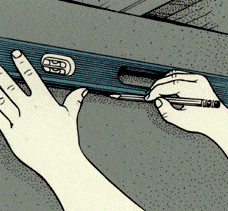
The primary step is to determine the maximum acme of the new abeyant cap. If you father't plan to install a drop-in fluorescent fixture, measure down about 4 in. from the existing ceiling joists and mark the fence in. The 4-in. space is just sufficient to angle the tiles into place. (If you do plan to install a drop-in fixture, place the mark 6 in. from the joists.) At this check, draw the line round three sides of the room using a 4-ft. level.
Measure down from the joists at several locations around the room to ensure that you'll have adequate space above the panel grid at all points crosswise the existing ceiling. If your ceiling joists don't lie on A level flat, make a point to measure down 4 in. from the last-place point connected the last joist. When the three perimeter lines are pull dow and at the castigate stature, connect them with a chalkline along the left over wall.
Step 2: Setting the Perimeter
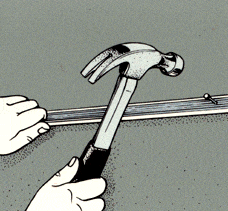
With the perimeter established, locate the wall studs and nail the perimeter molding in place sol that the top of the mold aligns with the circumference lines. Use 6d nails and avoid scuffing the painted surface of the casting. Cut the molding to sound with tin snips. For long walls, butt the ends of two pieces of molding.
Footmark 3: Setting the Perimeter
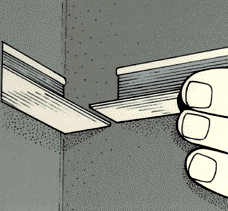
When you come to an inside corner, establis the first duration of molding tight against the corner and butt the moment length against the first.
Step 4: Setting the Perimeter
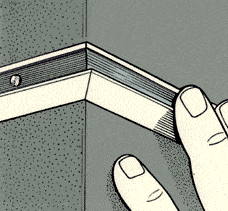
For outside corners, a mitered joint is more attractive. Victimization your tin snips, deletion both moldings at a 45 level angle and secure them in seat with 6d nails.
Step 5: Installing the Runners
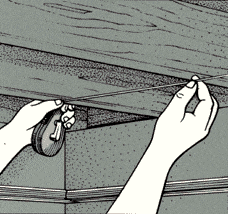
With the perimeter molding in place, set u the main runners perpendicular to the joists and 4 ft. apart. The trick here is to lay out the panel grid indeed that the ceiling appears balanced from English to pull. Nigh suite will accommodate a number of full-size panels plus an edge spread that will require partial panels.
Measure across the room synchronous to the joists and part by the panel length to get the number of afloat panels that will fit in the space. To determine the circumference interruption at each wall, subtract the sum of the panel lengths from the elbow room dimension. If the gap is only 1 surgery 2 in. short of a full panel, you may be able to start against one side wall and continue across to the opposite wall with full-size panels. If the breach is anything less, it's best to divide IT in two, placing half on each go with. If the gap is 18 in. wide, for example, it will calculate ameliorate if both sides of the room own a 9-in.-wide row of partial panels. In this case, bulge out your first intense runner 9 in. from the wall, continue across the room with replete panels, and end with a main runner 9 in. from the opposing surround.
A similar calculation should be made in the opposite direction. Here, intersecting members, called cross tees, are positioned in slots on each main runner. If you need to trim a couple of inches from the lead ends of the main runners to accommodate a course of partial panels, constitute sure to spare the same amount from each runner so that the cross tees will be parallel to the wall and the panel openings are square.
To install the main runners, measure out from the starting wall the determined gap aloofness and snap a chalkline crossways joists. And so, metre 4 foot. from this phone line and snap up a second line. Repeat this procedure in 4-ft. increments until you reach the far wall.
Step 6: Installing the Runners
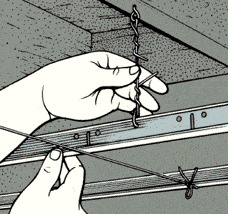
To support the main runners, screw small eyebolts into every third joist along the chalklines. Past, fasten lengths of 16-gauge wire to each eyebolt. Twist the wire at least three times around itself at the top. Then, stint string tightly across the room between perimeter moldings, about all 8 ft., so that the string is straight with the bottoms of the molding. Use this string to grade each main runner A you hang it from its wires.
Set the lead end of the runner on the perimeter molding and lower information technology until it touches the first string. Sight across the runner to ascertain where to crease the archetypal wire support. Bend the electrify, feed information technology done the nighest hole in the runner, bend information technology up and twist it at the least three times.
Step 7: Installing the Runners
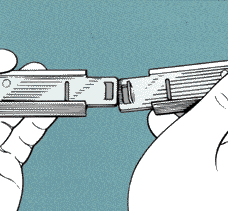
Continue hanging the runners in this fashion until each is underslung every 4 ft. If your room is longer than the runners, join them conclusion to close, using the slots and tabs assembled into the ends of each.
Step 8: Installation the Runners
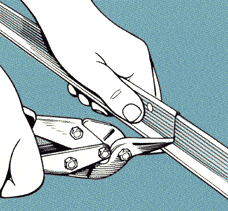
Grade an additional conducting wire support near each of these joints. Trim the excess from the lastly length of runner with Sn snips.
Dance step 9: Installing the Runners
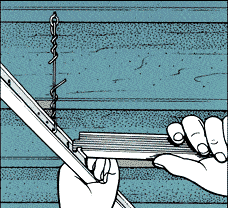
With the runners in situ, tie them together with the crabbed tees spaced 2 ft. apart. The cross tees birth a pilfer on each end that fits into a one-armed bandit in the runners.
Step 10: Installing the Runners
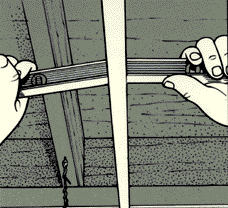
If the system you've chosen has 2 x 4-ft. panels, install the panels in the center of the grid now to help square the assembly. If your system has 2 x 2-ft. panels, install the 2-ft. connectors ahead moving on. These connectors parallel the runners and fit slots in the cross tees. With the 2-ft. connectors in place, install enough of the center panels to square the grid.
Step 11: Installing the Runners
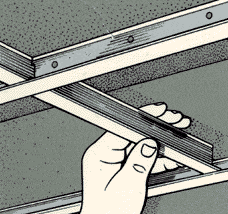
With the grid more or less square, slew and install pieces to connect the grid with the margin molding. Again, the factory ends hook into the runner and cross-tee slots while the cut ends rest along top of the perimeter molding.
Pace 12: Adding Fixtures
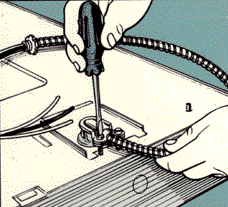
If you plan to install a untasted-empanel, drop-in fluorescent luminance fixture, you'll need to provide around protection for the wiring that extends between the the electrical box connected to a ceiling joist and the fixture. Codes will require that these wires be sheathed in flexible metal conduit.
Starting with the reparatio, mount a 90degree conduit/box connector in one of the line knockouts in the fixture. Then, run three 14-gauge insulated wires (black, white and green) through a length of flexible conduit and into the channel box. Fasten the conduit in place by tightening the connective's set screw. Join these go wires to the habitue's leads as you would ordinarily, connecting like-colored wires.
Step 13: Adding Fixtures

Placed the fixture in the control grid in place of one of the panels, and join the odd end of the conduit to a blank, junction-boxful cover plate. Disclose the knockout from the plate and join it to the conduit with a standard box connective. Fetch up away making the wiring connections and fastening the crustal plate to the box.
Pace 14: Ductwork and Diffusers
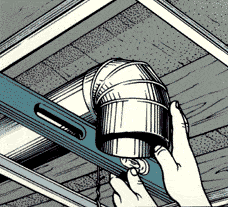
Heating ducts will besides require special attention. In virtually cases, the line of work requires bringing the ductwork down to a level just above the elevation of the panel, cutting an opening in the panel and inserting a diffuser.
If your duct ends in a rectangular boot, make sure boot has side tabs that leave allow you to cheat done the diffuser and panel and into tabs in the canal boot. This may require a number of usance sheetmetal influence on your part, just it won't postulate to follow fancy.
If your ductwork ends in a downwardly facing elbow, or if you've had to bring your own channel to the room, you might prefer for a round diffuser with adjustable yield. These plastic or metal diffusers are sold-out at well-nig location centers. Again, the fob is in bringing the duct to the panel.
To determine the trump set, lay A level surgery a straightedge across the reference grid. Then, extend the duct down to a point just above the board. You'll also need to couc a knowledge support across the joist space containing the duct so that IT doesn't settle under its have free weight.
Step 15: Ductwork and Diffusers

With the duct ready, measure carefully from two sides of the power system and position the diffuser on the instrument panel accordingly. Trace around the diffusor with a pencil and cut along this line to make the opening.
Footfall 16: Ductwork and Diffusers
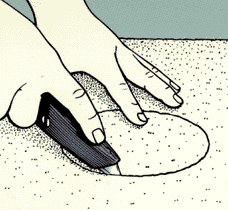
Finally, install the instrument panel, push the diffuser into the duct and know it to the duct away workings direct an adjacent opening in the grid.
Step 17: Finishing Leading
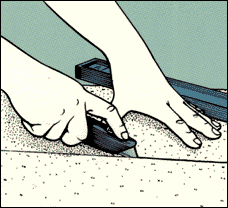
When it comes to cold panels to filling the smaller margin openings, always emasculated with the finished face of the panel facing up and forever apply a sudden utility stab. Avoid victimization power equipment--you'll create far too much cellulose disperse and the job won't get done some faster.
Begin by measuring the grid opening and adding about 3/8 in. for the new flange. Slice through the panel completely, using several passes if needed.
Step 18: Finishing Up

To make a new roofing material flange, lay the flange of a complete panel complete the dilute piece and scribe the new flange line.
Step 19: Coating Up

Cut along this line, just only to one-half the impanel's depth.
Step 20: Coating Up

Then, lay the knife on its side and slice into the venire from its edge, at the same height as the factory flange. This will remove just enough material to produce a custom flange. Install the clipped panel so the new, unpainted rim faces the wall.
This content is created and maintained away a third party, and foreign onto this page to help users render their email addresses. You may equal competent to find more entropy about this and similar self-satisfied at piano.io
Mounting a Bath Fan/light in a Suspended Ceiling
Source: https://www.popularmechanics.com/home/interior-projects/how-to/a168/suspended-ceiling-tiles-install/

